





When considering Bakuchiol vs Retinol, most people assume Bakuchiol is simply the gentler, plant-derived alternative to Vitamin A
While bakuchiol has earned a reputation for delivering many of the visible benefits associated with retinoids—including improved skin texture, enhanced firmness and a brighter complexion—without the irritation often associated with retinol, emerging research suggests there is considerably more to this botanical active.
A new 2026 review brings together genomic, mechanistic and clinical research suggesting that bakuchiol operates across multiple interconnected biological pathways involved in skin health, including antioxidant defence, inflammation, epidermal function, mitochondrial regulation and cellular resilience.
The important distinction is that not all of these findings have been demonstrated in human clinical trials. Some represent laboratory or animal-model evidence that helps researchers understand how bakuchiol may work.
In other words, the conversation around Bakuchiol vs Retinol is evolving.
Bakuchiol is no longer simply a retinol alternative. It is emerging as a sophisticated botanical active with a broader biological profile that warrants further research.
What Is Bakuchiol?
Bakuchiol is a naturally derived meroterpene extracted primarily from the seeds of the Babchi plant (Psoralea corylifolia).
Unlike retinol, bakuchiol is not a Vitamin A derivative and does not act as a classical retinoid receptor agonist.
Yet research has demonstrated meaningful functional overlap between the two ingredients, including effects on pathways associated with extracellular matrix remodelling, epidermal differentiation and skin barrier function.
This combination of retinol-like benefits and a different biological mechanism is what makes bakuchiol particularly interesting in modern skincare.
Bakuchiol vs Retinol: What’s the Difference?
For years, bakuchiol was described as a “retinol mimic”
That description isn’t entirely wrong—but it is now considered incomplete.
Research suggests that bakuchiol and retinol share some biological outcomes while arriving at them through different mechanisms.
Where Bakuchiol Matches Retinol
Both ingredients have been investigated for their ability to support several characteristics associated with healthier, more youthful-looking skin.
Collagen and Extracellular Matrix Support
Collagen is one of the primary structural proteins responsible for skin firmness and elasticity.
Studies have found that both bakuchiol and retinol can increase markers associated with extracellular matrix components, including collagen. A 2022 study found increases in collagen-related proteins following treatment with both ingredients.
Skin Renewal
Healthy epidermal renewal is essential for maintaining a smooth, luminous complexion. Experimental research has found that bakuchiol can influence epidermal regeneration and re-epithelialisation, with some models showing effects that were not observed with retinol under the same experimental conditions.
Visible Signs of Photoaging
A prospective, randomised, double-blind clinical study comparing topical bakuchiol with retinol found that both improved measures of facial photoaging, while bakuchiol was associated with fewer retinol-like irritation effects.
This is important because it provides human clinical evidence—not simply laboratory evidence—that bakuchiol can deliver meaningful cosmetic benefits.
Where Bakuchiol May Go Beyond Retinol
The most interesting aspect of the emerging research is not that bakuchiol is “better” than retinol
It is that bakuchiol appears to do some things differently.
The 2026 review describes several pathways that extend beyond the conventional retinoid model, including Nrf2-mediated antioxidant defence, inflammatory signalling, retinoid metabolism, mitochondrial regulatory mechanisms and FOXO3-related pathways.
Importantly, these findings should be interpreted according to the type of evidence supporting them.
Some are demonstrated in cellular or reconstructed-skin models, while others come from animal or mechanistic research. They provide compelling insight into how bakuchiol may function, but they should not be interpreted as proof that topical bakuchiol extends human lifespan or directly reverses cellular aging.
That distinction makes the science more—not less—interesting.
Bakuchiol and Cellular Energy
Every process involved in maintaining healthy skin requires cellular energy
Collagen synthesis, epidermal renewal, barrier maintenance and cellular repair are metabolically demanding processes.
Mitochondria play a central role in cellular energy metabolism, and mitochondrial dysfunction is recognised as one component of biological aging.
The 2026 review describes emerging evidence that bakuchiol interacts with mitochondrial regulatory systems and may influence pathways involved in mitochondrial function, metabolic adaptation and cellular stress responses.
These findings are particularly intriguing because they suggest that bakuchiol’s activity may extend beyond simply encouraging surface-level renewal.
However, the distinction between mechanistic evidence and proven clinical outcomes is important.
The current research provides evidence that bakuchiol can influence mitochondrial-related pathways in experimental models. It does not yet establish that topical bakuchiol directly increases cellular energy production in human skin or produces a measurable “longevity” effect in people.
This is an exciting area of research—and one that deserves further clinical investigation.
Bakuchiol and Antioxidant Defence
Oxidative stress is an important contributor to skin aging
Reactive oxygen species can affect cellular structures, proteins and the extracellular matrix, contributing to the visible changes associated with environmental and chronological aging.
Bakuchiol has demonstrated antioxidant activity in experimental studies, and the 2026 review highlights activation of Nrf2-related cytoprotective pathways and increased expression of antioxidant enzymes such as NQO1.
This provides an interesting point of difference from the traditional retinol story.
Rather than viewing bakuchiol solely as an ingredient that stimulates renewal, researchers are investigating its potential to support the skin’s own protective response to oxidative stress.
A 2022 study also found stronger antioxidative activity for bakuchiol than retinol in the experimental models used.
Bakuchiol and Skin Longevity
The concept of skin longevity goes beyond reducing the appearance of wrinkles
It asks a broader question:
How can we support skin so that it continues to function well as it ages?
This includes maintaining:
- Barrier integrity
- Cellular resilience
- Healthy epidermal renewal
- Antioxidant defence
- Extracellular matrix integrity
- Balanced inflammatory responses
The 2026 review is particularly interesting in this context because it discusses bakuchiol’s relationship with conserved longevity-associated pathways, including FOXO3 signalling.
However, there is an important scientific distinction.
Evidence connecting bakuchiol with FOXO3-related longevity pathways includes in-vivo evidence from Caenorhabditis elegans. This is valuable mechanistic evidence, but it cannot be directly translated into a claim that bakuchiol extends human lifespan or “activates human longevity genes” in the same way.
What it does provide is a fascinating biological hypothesis: bakuchiol may interact with conserved cellular stress-response pathways that are relevant to resilience and healthy aging.
That is a much more scientifically meaningful—and honest—way to talk about skin longevity.
Bakuchiol for Sensitive Skin
One of bakuchiol’s most compelling advantages is its skin tolerance
Retinol can cause irritation, dryness, erythema and peeling, particularly when introduced too quickly or used at higher concentrations.
In the clinical comparison of bakuchiol and retinol, both ingredients improved signs of facial photoaging, while the retinol group experienced more scaling and stinging.
This makes bakuchiol particularly interesting for people who want to incorporate a skin-renewing active into their routine without accepting significant irritation as part of the process.
And because long-term skincare is ultimately about consistency, tolerability matters. An active that can be used comfortably and consistently has an important practical advantage.
Bakuchiol vs Retinol: The Evidence in Perspective
| Evidence / Benefits | Bakuchiol | Retinol |
|---|---|---|
| Skin renewal | Supported by experimental and clinical evidence | Well established |
| Collagen / ECM support | Supported | Well established |
| Antioxidant activity | Strong experimental evidence | Less pronounced direct antioxidant activity |
| Mitochondrial pathways | Emerging mechanistic evidence | Not a primary mechanism |
| FOXO3 / longevity pathways | Emerging experimental evidence | Not established as a primary mechanism |
| Skin tolerance | Generally well tolerated | Irritation is common |
| Human clinical evidence | Increasing | Extensive |
The most accurate conclusion is not that bakuchiol has definitively replaced retinol.
Rather, the evidence suggests that bakuchiol and retinol overlap in some important biological outcomes while differing in their mechanisms and tolerability profiles.
That distinction is what makes bakuchiol so interesting.
How Bakuchiol Is Made Matters
Traditional Retinol: Industrial Vitamin A Chemistry
Cosmetic retinol is manufactured through chemical synthesis rather than being extracted directly from a plant.
The final molecule is chemically identical to naturally occurring retinol, but its manufacture involves industrial chemical synthesis.
Retinol is also inherently unstable and can be sensitive to oxygen, light and heat, making formulation and packaging important considerations.
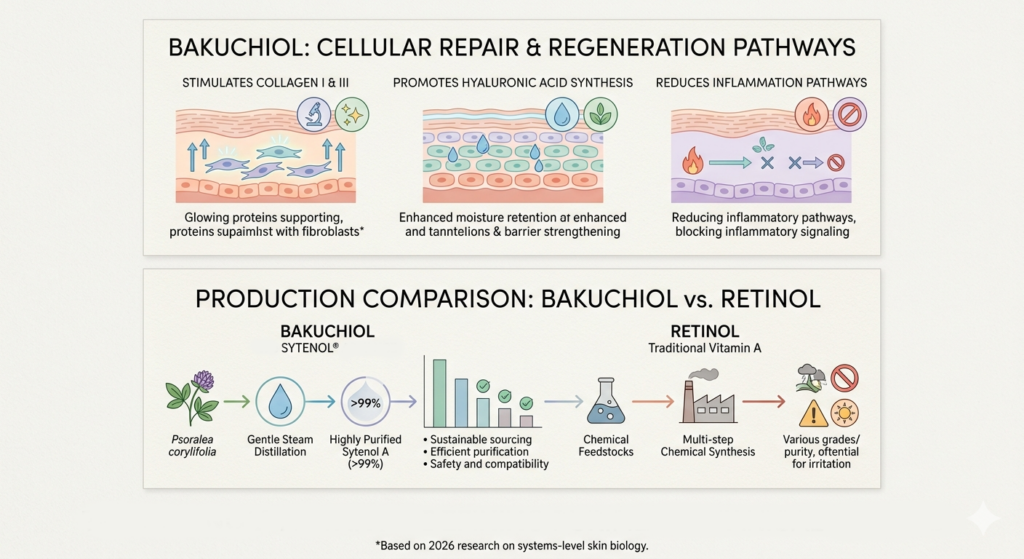
Sytenol® A Bakuchiol: Precision Botanical Extraction
Bakuchiol begins with the seeds of the Babchi plant (Psoralea corylifolia).
However, crude botanical extracts contain a complex mixture of naturally occurring compounds. For cosmetic use, purification is therefore important.
Sytenol® A, the bakuchiol selected for TANU, is a highly purified form of bakuchiol designed to provide a consistent concentration of the active molecule.
This distinction matters.
There is a significant difference between using a crude botanical extract and using a purified, analytically characterised cosmetic active.
Why We Use Sytenol® A in TANU
At Fifty7Kind, we selected Sytenol® A Bakuchiol for TANU Skin Affinity Coactive Serum because it fits our philosophy of supporting healthy skin function rather than relying on aggressive correction.
TANU combines bakuchiol with Aroleat Samphira® Sea Fennel, Coenzyme Q10 and Oat Lipid e, creating a multi-dimensional approach to skin renewal and resilience.
- Bakuchiol: Supports skin renewal and visible refinement.
- Sea Fennel: Supports a smoother, more even-looking complexion and complements the renewal activity of bakuchiol.
- Coenzyme Q10: Provides antioxidant support and contributes to TANU’s focus on cellular vitality.
- Oat Lipid E: Provides a nourishing lipid environment containing ceramides and other skin-supportive lipids, helping complement the renewal-focused actives.
Together, these ingredients create a formulation designed around renewal + resilience + replenishment.
Discover TANU Skin Affinity Coactive Serum
The Future of Skin Longevity
The future of skincare is moving beyond aggressive correction.
Instead of focusing solely on visible signs of aging, skin longevity asks how we can support the biological processes that allow skin to maintain its structure, resilience and function over time.
Bakuchiol fits naturally into this emerging philosophy.
The research suggests activity across several interconnected areas:
- Skin renewal
- Extracellular matrix support
- Antioxidant defence
- Inflammatory signalling
- Barrier function
- Cellular stress responses
- Mitochondrial regulation
- Longevity-associated pathways
Some of these effects are already supported by human clinical evidence, while others remain promising areas of mechanistic research.
Together, they create a compelling picture of an ingredient that deserves to be studied for more than its ability to mimic retinol.
The Takeaway
For years, bakuchiol was positioned as the gentler alternative to retinol.
But the science behind Bakuchiol vs Retinol is becoming much more nuanced.
Clinical research demonstrates that bakuchiol can improve several visible signs of photoaging, while experimental studies reveal antioxidant, anti-inflammatory, extracellular matrix and epidermal-regeneration activity.
The newer 2026 research takes the conversation further, proposing that bakuchiol may interact with interconnected biological networks involving oxidative stress, mitochondrial regulation, retinoid metabolism and longevity-associated signalling.
Some of these findings remain mechanistic or preclinical and require further human research. And that is precisely what makes this field so exciting. Bakuchiol may not simply be a gentler retinol. It may be part of a new generation of skincare actives designed around skin resilience, biological function and longevity.
For those seeking visible results without making irritation the price of efficacy, bakuchiol offers a compelling alternative.
Not a compromise.
A different way of thinking about skin aging.
Discover TANU
TANU Skin Affinity Coactive Serum brings together Sytenol® A Bakuchiol, Sea Fennel, Coenzyme Q10 and Oat Lipid E in a daily skin-renewal formulation designed around skin affinity, supporting long-term skin health and vitality.
Renew. Refine. Rebuild.
Explore TANU Skin Affinity Coactive Serum
Related Reading
- Why Your Skin Is Your Health Regulator
- TANU Skin Affinity Coactive Serum
- How Menopause Changes Your Skin
- Understanding Skin Longevity
Until next time, be human, be kind, be you

References
Chaudhuri, R.K. (2026). Bakuchiol: From structural mimicry to systems-level skin biology. International Journal of Cosmetic Science. Published online 22 June 2026. DOI: 10.1111/ics.70116.
Read the 2026 review
Dhaliwal, S. et al. (2019/2020). Prospective, randomized, double-blind assessment of topical bakuchiol and retinol for facial photoageing. British Journal of Dermatology, 180(2), 289–296.
View the PubMed record
Bluemke, A. et al. (2022). Multidirectional activity of bakuchiol against cellular mechanisms of facial ageing – Experimental evidence for a holistic treatment approach. International Journal of Cosmetic Science, 44(3), 377–393. DOI: 10.1111/ics.12784.
Read the full research paper
Sytheon. Sytenol® A Bakuchiol.
View Sytenol® A ingredient information







Comments +